Good Stuff. No Fluff.
Freebooksy and BookBub Deals Crush It in Book Sales
In today’s crowded book marketplace, visibility remains the greatest challenge for authors at every level. With millions of titles competing for reader attention, strategic promotion has become essential for success. Freebooksy and BookBub stand out as two of the most effective promotional platforms for authors seeking to increase their books’ visibility and drive sales.
These platforms have transformed book marketing by connecting readers hungry for deals with authors looking to expand their audience. They operate on a simple premise: readers sign up to receive notifications about free or discounted books in their preferred genres, creating a targeted audience of active book buyers.
BookBub boasts over 20 million subscribers, while Freebooksy reaches more than 480,000 dedicated readers across various genres.
This article provides practical strategies for leveraging these powerful platforms to maximize your book’s visibility, grow your readership, and increase your sales both during and after promotions.
Understanding Freebooksy and BookBub
What is Freebooksy?
Freebooksy is a book promotion service operated by Written Word Media that connects authors offering free books with readers looking for new content. The platform sends daily emails to subscribers featuring selected free ebooks grouped by genre.
When your book is featured on Freebooksy, it appears in the email newsletter sent to subscribers who have specifically requested books in your genre. This targeted approach ensures your book reaches readers already interested in your type of content.
The service offers promotions across major genres including mystery, romance, science fiction, fantasy, and non-fiction. Cost varies by genre, reflecting subscriber numbers and download potential.
“Freebooksy gave my mystery novel the push it needed. I hit #1 in my category and gained over 12,000 downloads in a single day. More importantly, I saw sell-through to my other books for weeks afterward.” – Mystery author Michael Collins
Freebooksy promotions typically cost between $40-$100 depending on genre, with romance and mystery categories commanding higher prices due to larger subscriber bases.
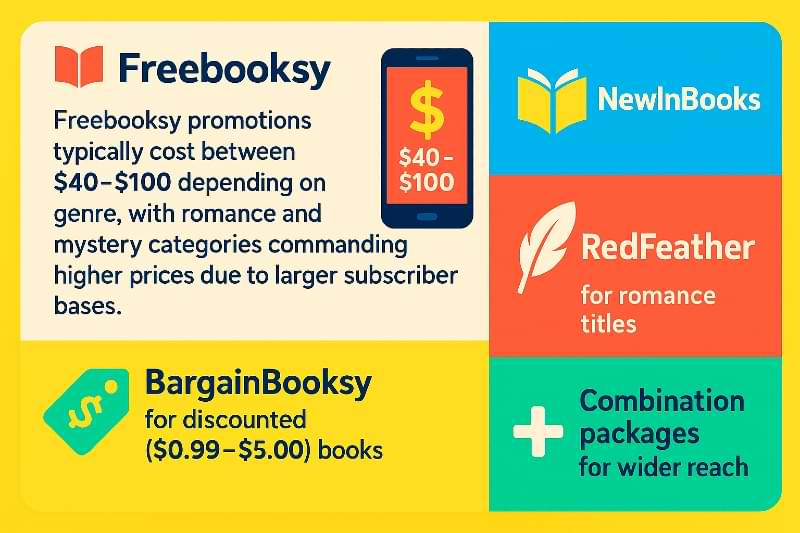
The platform also offers related services:
- BargainBooksy for discounted ($0.99-$5.00) books
- NewInBooks for new releases
- RedFeather for romance titles
- Combination packages for wider reach
What is BookBub?
BookBub represents the premium tier of book promotion services, reaching over 20 million highly engaged readers across multiple countries. Launched in 2012, it has established itself as the gold standard for ebook promotions.
The platform’s primary offering, Featured Deals, places selected books in daily emails sent to subscribers based on their genre preferences. These deals are highly competitive, with an acceptance rate of only 10-20% of submissions.
BookBub Featured Deal costs range from $168 for free international horror books to $2,800 for $2.99 U.S. women’s fiction titles.
BookBub’s effectiveness stems from its massive reach and the trust readers place in its recommendations.
BookBub Promotion Results
This chart shows the average number of downloads achieved during BookBub promotions across different genres, comparing both free and discounted book campaigns. Romance and mystery consistently show the highest performance, while non-fiction titles see lower but still significant download numbers.
BookBub Promotion Results by Genre
Average performance metrics from Featured Deals
0
10,000
20,000
30,000
40,000
50,000
Romance
Mystery
Fantasy
Sci-Fi
Non-Fiction
General
48,500
45,200
42,000
38,500
26,200
34,300
37,500
33,800
30,200
28,400
18,800
22,500
Free Book Promotions
Discounted Book Promotions
Average Downloads
This data is compiled from thousands of BookBub promotions across different price points. Free book promotions consistently outperform discounted promotions in terms of raw download numbers, but discounted promotions often provide better ROI and higher conversion rates to subsequent book purchases.
Unlike Freebooksy, BookBub operates on a selective curation model rather than a paid placement system.
While you pay if selected, submission is free, and selection depends on:
- Book quality and professional presentation
- Price point and discount depth
- Review quantity and quality
- Author platform and track record
- Current promotional needs in your genre
Key Differences Between Platforms
While both platforms connect books with readers seeking deals, understanding their key differences helps determine which best suits your marketing goals.
Freebooksy offers guaranteed placement for a fee, making it accessible to new authors and those with fewer reviews. BookBub provides potentially larger exposure but with competitive selection requiring stronger platform metrics.
The audience distinction is significant: BookBub’s larger subscriber base includes many casual readers attracted by deals, while Freebooksy tends to attract more dedicated readers who frequently download free books across multiple genres.
Industry insiders note that BookBub subscribers tend to have higher conversion rates from free to paid books, particularly in romance and mystery genres.
BookBub also offers a more robust ecosystem including author follows, recommendations, and advertising options beyond featured deals.
“I view Freebooksy as my reliable monthly promotion and BookBub as my quarterly home run attempt. Both serve different purposes in my marketing strategy.” – Romance author Jennifer Hayes
BookBub’s interface also allows more reader interaction:
The platforms also differ in how they present books to readers, with BookBub’s minimalist approach contrasting with Freebooksy’s more detailed listings.
Preparing Your Book for Promotion
Optimizing Your Book Details
Before submitting to either platform, ensure your book presentation meets professional standards. Both services review your book’s public-facing elements before acceptance.
Book covers require particular attention as they represent the first—and often only—chance to grab a reader’s attention. For promotions, covers need to:
- Clearly signal genre through imagery, typography, and color palette
- Remain legible when reduced to thumbnail size
- Match or exceed the quality of bestsellers in your category
- Feature professional typography and design elements
Book Descriptions
Book descriptions play an equally crucial role, serving as your sales pitch to potential readers.
Before/After Example:
Original Description:
“John Smith is a detective who has seen it all. When a body shows up in the river, he knows this case is different. Can he solve it before the killer strikes again? This exciting mystery will keep you guessing until the end.”
Optimized Description:
“Detective John Smith thought the serial murders had stopped. Until a familiar signature appeared on a fresh corpse pulled from the Mississippi.
The Riverside Killer has returned after five years of silence.
With the police chief demanding results and the mayor breathing down his neck, Smith must confront his own demons to catch a killer who knows his every move—because this time, the killer is someone from his past.
Perfect for fans of Michael Connelly and Tana French, this heart-stopping police procedural will keep you turning pages late into the night.”
- Create a professional, genre-appropriate cover
- Write a compelling book description using strong hooks
- Select categories that balance visibility with relevance
- Price strategically based on genre and length expectations
- Accumulate genuine reviews before submission
- Format your book professionally with clean navigation
Timing Your Promotion
Strategic timing dramatically affects promotion outcomes. Data shows certain days of the week perform better for specific genres.
For fiction titles, promotions that run Thursday through Saturday typically generate the highest download numbers, while non-fiction books often perform better early in the week.
Critical timing factors:
Seasonal trends affect different genres uniquely. Romance titles see spikes around Valentine’s Day and summer beach reading season. Mystery and thriller promotions perform well in fall and winter months.
Calendar of high and low periods: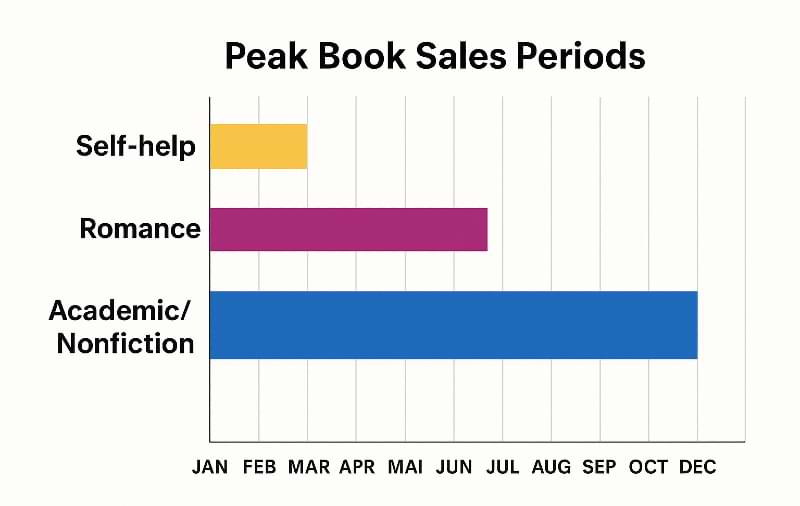
The promotion schedule relative to your publication history also matters:
- For new releases: Schedule 3-4 weeks after launch to capitalize on algorithms
- For backlist: Coordinate with related title releases or series completions
- For series books: Time with next release pre-orders becoming available
Plan Freebooksy promotions 2-3 weeks in advance and submit BookBub Featured Deals 4-6 weeks before your ideal promotion date to account for the selection timeline.
Budget Planning
Effective promotion budgeting requires understanding both costs and potential returns. Each platform offers different value propositions based on your specific goals.
For new authors testing promotional waters, Freebooksy provides lower entry costs with reliable results. Established authors can leverage BookBub’s premium pricing for exponentially larger reach when launching new series or revitalizing backlist titles.
Average ROI based on collected author data:
These figures vary significantly by genre, with romance and thriller categories typically seeing higher performance metrics than literary fiction or specialized non-fiction.
The key to maximizing ROI is having a complete series or multiple books available. First-in-series promotions drive the highest returns when readers can immediately purchase subsequent books.
Freebooksy Promotion Strategies
Types of Freebooksy Promotions
Freebooksy offers several promotional options tailored to different book types and author goals.
The standard Freebooksy feature remains their core offering, promoting free books to genre-specific subscriber lists. Pricing varies by genre, with the most popular categories commanding premium rates:
Romance: $100
Mystery/Thriller: $80
Science Fiction/Fantasy: $70
Non-Fiction: $40-60 (depending on category)
For books priced between $0.99-$4.99, BargainBooksy reaches a different subscriber base willing to pay for discounted rather than free books. These promotions often attract readers with higher conversion rates to full-priced purchases.
NewInBooks Promotions highlight recent releases to readers seeking the latest titles rather than bargains specifically. This service works well for books at full price rather than deeply discounted titles.
Written Word Media also offers combination packages bundling services together:
- Double Feature (Freebooksy + BargainBooksy): Promotes the same book first as free, then as paid
- Series Feature: Highlights multiple books in a series simultaneously
- Multi-Genre Feature: Promotes one book across several related genre newsletters
Submission Best Practices
Successful Freebooksy submissions require attention to detail and strategic timing. Start by selecting the most appropriate promotion type based on your book’s price point and your marketing goals.
When completing the submission form:
- Choose the most relevant primary genre for your target readers
- Select subgenres carefully to narrow targeting without limiting reach
- Provide all requested links to sales pages and ensure they function properly
- Submit 3-4 weeks before your desired promotion date for best scheduling options
The book description field deserves special attention as Freebooksy often uses this content directly in promotions. Focus on concise, engaging language that highlights the book’s strongest selling points.
“Avoid generic descriptions or excessive plot details. Instead, focus on emotional hooks and clear genre markers that will appeal to Freebooksy subscribers.” – Book marketing expert Alana Johnson
Common rejection reasons:
- Cover quality below professional standards
- Formatting issues visible in the sample
- Mismatch between book content and selected genres
- Insufficient reviews for premium genres
- Adult content not properly disclosed
When submitting, include notes explaining any unique selling points or previous promotion successes to help the Freebooksy team better position your book.
Maximizing Results from Freebooksy
To extract maximum value from a Freebooksy promotion, preparation before the feature date proves essential.
Pre-promotion checklist:
- Verify your book is properly categorized on all platforms
- Ensure your book appears in browse categories, not just search results
- Check that all series links and author page information are current
- Test the download process on major platforms to identify any issues
- Prepare social media announcements to amplify promotion
The promotional timeline for optimal results spans several days:
Day Before Promotion:
- Verify price changes are live on all platforms
- Set up Amazon Marketing Services (AMS) ads to capitalize on rank improvements
- Schedule social media announcements
Promotion Day:
- Monitor rankings for category penetration
- Share promotion with your email list (afternoon timing works best)
- Engage with readers downloading your book via social media
Days 1-3 After Promotion:
- For free promotions, maintain the free price for 24-48 hours after feature
- Gradually raise prices on discount promotions over 2-3 days rather than immediately
- Launch follow-up AMS ads targeting category browsers
Days 4-7 After Promotion:
- Send email to your list announcing return to regular pricing soon
- Analyze category rank data and review activity
- Implement targeted promotions for subsequent series books
The key insight many authors miss is that the promotion itself is just the beginning. The algorithmic benefits often peak 2-3 days after the promotion when Amazon’s systems register the increased activity around your book.
BookBub Promotion Strategies
Types of BookBub Promotions
BookBub offers multiple promotional opportunities beyond its flagship Featured Deals program, each serving different marketing objectives.
Featured Deals remain the premier option, with books selected by BookBub’s editorial team sent to millions of subscribers. These deals require significant discounting (free or at least 50% off regular price) and undergo competitive selection.
New Release Alerts notify BookBub followers when authors they follow release new books. Unlike Featured Deals, these alerts go only to your established followers rather than the entire subscriber base in your genre.
BookBub Ads provide a self-serve advertising platform allowing precise targeting by author interest, genre, and retailer preference. These ads appear in BookBub’s daily emails and on their website with CPC (cost-per-click) bidding.
Key differences in BookBub promotional types:
BookBub Featured Deal Criteria
🔍 Core Eligibility Criteria
- Professional Presentation: Cover must fit the genre and be visually clean. No typos or formatting issues.
- Wide Availability: Must be live on Amazon, Apple Books, Barnes & Noble, Kobo, or Google Play.
- Pricing Requirements: Book must be priced at $0.99 or free during the promotion, and price must be consistent across platforms.
- First in Series: Free promos are more likely to be approved if it’s the first book in a series.
✅ Preferred Book Attributes
- At least 50+ reviews with a 4.0+ average on Amazon.
- Strong sales velocity or historical sales performance.
- Author is well-known or published traditionally.
- Series books are prioritized, especially Book 1.
📚 Genre-Specific Expectations
- Romance & Mystery: Higher review and sales expectations due to high competition.
- Nonfiction & Memoir: More flexibility if topic is unique or timely.
- Diverse Voices: Increasing support if paired with a strong hook.
🛠️ Other Notes
- First-time authors may struggle unless the book is free and highly polished.
- Even if rejected, you can use BookBub Ads to reach readers.
International deals deserve special consideration, often providing better values with lower competition. BookBub offers region-specific promotions for the US, UK, Canada, Australia, and India markets.
Increasing Your Chances of Selection
Given BookBub’s selective nature, strategic submissions dramatically improve acceptance odds. Understanding the selection criteria helps craft stronger applications.
Track record matters significantly. Books with strong sales history, numerous positive reviews, and professional presentation receive priority consideration. For new releases, author history carries similar weight.
Strategic submission factors that increase acceptance rates:
- Timing submissions seasonally based on genre trends
- Offering deeper discounts than the minimum required
- Including all available territories rather than US-only
- Submitting during less competitive timeframes (mid-month)
- Creating a compelling retailer mix (not Amazon-exclusive)
The initial book elements BookBub editors evaluate include:
“BookBub isn’t just looking at your book in isolation—they’re considering whether it fits their current promotional mix and subscriber needs. Timing submissions when similar books haven’t been featured recently increases your chances.” – BookBub Partners Blog
Historical data suggests mysteries and thrillers see higher acceptance rates (15-20%) compared to romance and fantasy (8-12%) due to different submission volumes.
After rejection, waiting 4-6 weeks before resubmission proves optimal, ideally with improvements to the book’s presentation or review count.
Maximizing Results from BookBub
A BookBub Featured Deal generates maximum impact when leveraged throughout your author platform ecosystem. The promotion timeline extends well beyond the feature date itself.
Promotion Timeline:
One Week Before:
- Verify pricing changes across all retailers
- Prepare newsletter and social media announcements
- Set up tracking links for different promotional channels
- Schedule complementary promotions on smaller sites
Day of Promotion:
- Monitor rankings hourly across major retailers
- Share promotion with your email list in the afternoon
- Engage with comments on BookBub’s feature
- Track category rank penetration
Days 1-3 After:
- Maintain promotion price for optimal algorithm benefits
- Launch AMS ads targeting new-to-you authors in your genre
- Send emails to new readers with next-book information
- Begin gradual price increases for discount deals
Days 4-14 After:
- Implement series-specific promotions for sell-through
- Analyze retailer-specific performance data
- Launch targeted social media ads to readers of similar authors
- Send welcome sequence to new mailing list subscribers
BookBub promotions create what industry insiders call the “BookBub bump”—a sustained period of increased visibility and algorithm preference. This window typically lasts 2-3 weeks after the promotion, providing opportunity to establish longer-term visibility.
For series authors, the sell-through strategy becomes paramount. Data shows readers acquired through BookBub convert to full-price purchases at rates of 5-15% depending on genre and series completion status.
Measuring Success and ROI
Key Performance Indicators to Track
Effective promotion evaluation requires tracking specific metrics that indicate true performance beyond simple download numbers.
Primary KPIs to monitor include:
- Total downloads/sales during promotional period
- Category rank improvement and duration
- Sell-through to other series books (percentage and volume)
- Email signup conversion rate from book readers
- ROI based on both immediate and 30-day revenue
- Review acquisition (quantity and quality)
- “Also bought” listings on retailer sites
Sales rank tracking proves particularly valuable, with sustained rank improvements indicating stronger algorithmic positioning.
The difference between successful and exceptional promotions often appears in the long tail—the extended period after the promotional spike where continued elevated sales indicate true market penetration.
Authors should distinguish between vanity metrics (like raw download numbers for free books) and revenue-predictive metrics (like read-through rates and follow-up purchases).
Tracking Tools and Methods
Several tools help authors monitor promotion performance across multiple dimensions.
For Amazon-focused authors, Publisher Rocket provides category and keyword tracking to measure visibility improvements. Book Report offers sales aggregation for comprehensive revenue analysis across the Amazon ecosystem.
For wide authors (publishing across multiple platforms), Draft2Digital’s sales dashboard combined with individual retailer reports provides the necessary data breadth.
A simple but effective tracking spreadsheet includes:
- Daily sales/downloads by retailer
- Category rank by retailer (morning/evening)
- Sales of non-promoted books during campaign
- New email subscribers
- New reviews posted
- Traffic to author website/landing pages
Attribution tracking through unique links helps identify which promotion elements drive the strongest results.
For BookBub specifically, the Partners Dashboard provides promotion-specific data including clicks, conversions by retailer, and comparative performance metrics.
Analyzing Results to Inform Future Promotions
Systematic analysis transforms promotion data into actionable insights for future marketing decisions.
Start by comparing performance against both averages for your genre and your own historical results. Significant deviations in either direction warrant deeper investigation.
Key comparative questions include:
- Which retailers showed strongest/weakest performance?
- How did this promotion compare to previous ones for the same book?
- What was the sell-through rate to subsequent series books?
- Which timing factors may have influenced results?
- How did this promotion’s ROI compare to other marketing channels?
The analysis should distinguish between book-specific factors (cover, blurb, reviews) and promotion-specific factors (timing, platform, price point).
Authors report that promotion stacking—using Freebooksy to build initial momentum before a BookBub feature—increases BookBub performance by an average of 15-30% compared to standalone promotions.
For series authors, calculating the Customer Lifetime Value (CLV) provides the true promotion ROI beyond immediate sales. This requires tracking read-through rates and average books purchased per new reader.
Advanced Strategies for Maximum Impact
Stacking Promotions
Coordinating multiple promotional services around a single book creates compound visibility effects that exceed what any single promotion can achieve.
Effective stacking arranges services in ascending order of impact, building momentum that algorithms reward with improved visibility. A typical stack might include:
Day 1: Smaller genre-specific newsletters
Day 2-3: Mid-tier services (ENT, Robin Reads)
Day 4: Freebooksy
Day 5: BookBub Featured Deal
Days 6-7: AMS and Facebook ads targeting similar authors
This approach creates sustained download activity rather than a single-day spike, which recommendation algorithms favor when calculating popularity.
Critical stacking considerations:
- Space services 24-48 hours apart to avoid cannibalization
- Ensure all services can accommodate your specific promotion dates
- Build toward the highest-impact service rather than leading with it
- Maintain consistent pricing across the promotional period
- Account for different time zones in scheduling
Different genres respond to different stacking approaches. Romance and mystery readers often respond to higher promotion frequency, while literary fiction and non-fiction readers show fatigue with too-frequent discounting.
Series-Specific Strategies
Series books benefit from distinct promotional approaches that capitalize on reader completion behavior.
The series funnel concept visualizes how readers progress from initial discovery through complete series consumption:
First-in-series free or deeply discounted promotions generate the highest ROI when:
- At least three books in the series are available
- The series maintains consistent quality throughout
- Books are clearly linked through retailer series pages
- Subsequent books are priced appropriately for the genre
Series completion rates vary significantly by genre:
- Romance: 45-65% completion rates
- Mystery/Thriller: 50-70% completion rates
- Fantasy/Sci-Fi: 60-80% completion rates
- Non-Fiction: 20-40% completion rates (topic-dependent)
For maximal sell-through, price subsequent series books strategically. Data suggests pricing book two slightly lower than later books increases series momentum.
Box sets serve as both discovery and completion vehicles. Promoting complete series collections works best for series with 3-5 books, while sampling box sets (containing first-in-series for multiple series) helps cross-pollinate readership.
Case Studies and Success Stories
Fiction Case Study: Thriller Series Launch
Author Robert Chen used a coordinated promotion strategy to launch his five-book thriller series. Starting with only 200 mailing list subscribers, he implemented a multi-phase approach:
Phase 1: Foundation Building
- Released three books in the series over six months
- Built review base through ARCs (Advanced Reader Copies)
- Created professional series branding and category optimization
Phase 2: Initial Promotion
- Ran Freebooksy promotion for book one (priced free)
- Results: 4,300 downloads, reached #1 in Espionage Thrillers
- Used free promotion to build mailing list to 850 subscribers
- Saw 8% conversion to book two purchases
Phase 3: BookBub Featured Deal
- Secured BookBub Featured Deal three months after Freebooksy
- Coordinated with smaller promotions on days leading to BookBub
- Results: 32,000 downloads, maintained #1 in category for five days
- Sell-through to book two: 12% at $2.99 price point
- Mailing list growth to 2,200 subscribers
Key Metrics:
- Total promotion investment: $675
- 30-day revenue: $4,850
- 90-day revenue: $11,200
- ROI: 1,560% over 90 days
Critical success factors identified:
- Building review base before major promotions
- Strategic timing between promotional pushes
- Mailing list integration at each step
- Complete series availability at time of promotion
Non-Fiction Case Study: Business Book Promotion
Business author Sandra Martinez used a different approach for her standalone business leadership book. With an existing platform as a consultant, she focused on leveraging promotions for authority building rather than pure sales revenue.
Strategy Components:
- Limited-time discount ($0.99 from $9.99) rather than free promotion
- BargainBooksy feature for business category
- BookBub Ads targeting readers of competing titles
- BookBub Featured Deal (after two rejections)
Results:
- Downloads during BookBub: 8,400 copies
- Amazon category bestseller for 16 days
- Speaking engagement inquiries increased 340%
- Consulting lead generation up 280%
- Email list growth: 1,200 new subscribers
Revenue Analysis:
- Direct book revenue: $2,900
- Attributed consulting revenue: $28,000
- Course sales increase: $12,500
- ROI considering indirect revenue: 4,100%
“The BookBub promotion transformed my book from a business card to a lead generation engine. The authority boost from hitting bestseller status opened doors that had been previously closed.” – Sandra Martinez
Common Mistakes to Avoid
Submission Errors
Common submission mistakes dramatically reduce promotional effectiveness or lead to outright rejection.
Deadline miscalculations top the list of preventable errors. Authors frequently fail to account for the lead time required to secure ideal promotion dates, especially during popular promotional periods like holiday seasons.
Category selection errors cost authors significant visibility. Selecting overly competitive categories rather than strategic subcategories limits ranking potential and discoverability.
Other critical submission errors include:
- Submitting books with less than 5 reviews to BookBub (10-15 minimum recommended)
- Inconsistent pricing across retailers
- Broken links in submission forms
- Low-resolution cover images
- Formatting errors visible in book samples
BookBub editors note that resubmissions with the same material have lower acceptance rates. Making meaningful improvements before resubmission significantly increases selection odds.
Pricing Mistakes
Pricing errors undermine promotion effectiveness even when books secure features.
Insufficient discount depth represents the most common pricing mistake. BookBub requires discounts of at least 50%, but data shows deeper discounts (70%+) generate higher conversion rates and improved algorithmic performance.
Timing price changes incorrectly causes promotional disasters. Prices should change 24-48 hours before the promotion date to ensure all retailers reflect the correct price when newsletters deploy.
Post-promotion pricing strategy proves equally important. Immediate price increases after promotions cut short the algorithmic benefits of increased sales activity. Gradual price increases over 3-5 days maintain momentum while maximizing revenue.
Authors report that extending free promotions 24-48 hours beyond the featured newsletter date increases long-term results by 15-25% on average due to extended algorithm benefits.
Quick Takeaways
Freebooksy and BookBub provide powerful promotional platforms for authors at every career stage. While BookBub delivers a larger audience and greater prestige, Freebooksy offers reliable results with lower barriers to entry.
The most successful promotional strategies combine both platforms within a comprehensive marketing approach:
- Use Freebooksy to build initial momentum and a reader base
- Leverage that success to improve BookBub selection odds
- Implement strategic follow-up marketing to maximize promotion ROI
- Track detailed metrics to refine future promotional efforts
Key action steps:
- Prepare your book with a professional cover, compelling description, and strategic categorization
- Start with Freebooksy to establish promotion viability for your title
- Build review base and platform metrics to improve BookBub chances
- Submit to BookBub with detailed notes on previous promotion success
- Implement comprehensive tracking to measure true ROI
- Develop follow-up marketing to convert new readers into long-term fans
The authors who have achieved the greatest success view these promotions not as isolated events but as strategic components within an integrated marketing system that builds sustainable readership and consistent sales.